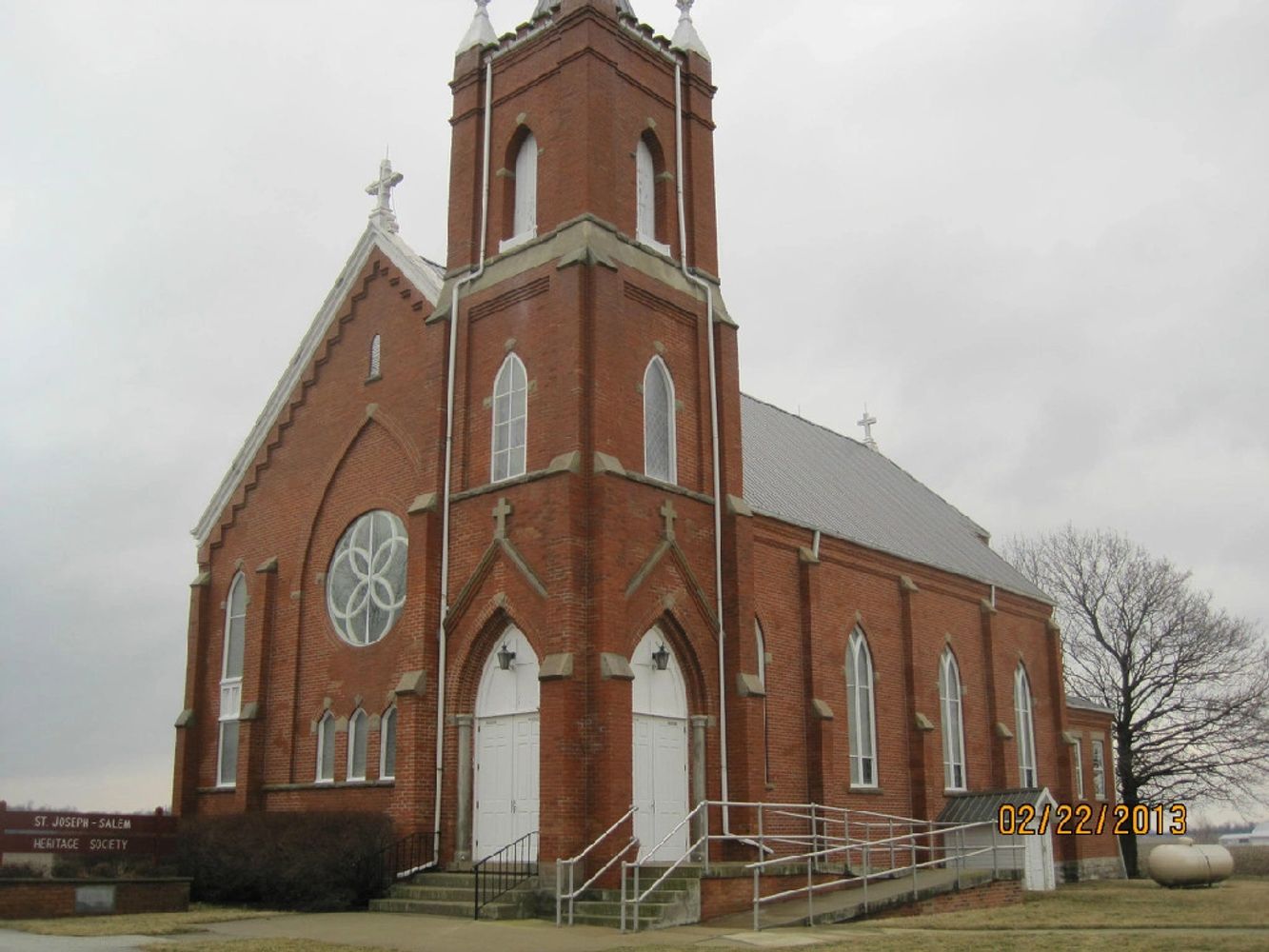
Bishop Leonard Blair of the Toledo Diocese, through his agent - Father Kent Kaufman, closed St. Joseph Parish as of July 3, 2005 after more than 155 years of steadfast service to the community and the Church. This site is now maintained as a reminder of this injustice so that more Catholics come to realize that they are in danger of similar ill-conceived decisions. It will hopefully serve as a communication link between those who love and respect the heritage given to them by the parish founders. It will also hopefully provide a communication link and show of support to all of those suffering the loss of their Christian Community.
Contact us: webmaster@salemstjoseph.org
Media Statement from St. Joseph – Salem Save Our Parish Society – Salem Township, Wyandot County, Ohio
1/22/2007 by M. E. Rall, Vice President
The St. Joseph-Salem Save Our Parish Society (The Society) is very pleased that their lawsuit over the closed parish property has recently taken a significant step forward. On January 16th, Judge Sumner E. Walters decreed that the Toledo Diocese’ motion to dismiss the suit, based on jurisdiction, is overruled. Hopefully, the case can now move on to a consideration of the issues.
The lawsuit was filed by the Society on June 28, 2006 in Wyandot County Common Pleas Court to gain control of the property of the Roman Catholic parish that was closed by the Toledo Diocese in July of 2005. The suit names Bishop Leonard Blair as defendant since the Bishop presently has title “in trust” of the property.
After the parishioners were locked out of the parish buildings in December of 2005 and efforts to meet with Bishop Blair were rebuffed, a majority of the parishioners formed the Society which was incorporated in April of 2006 “To recover, preserve and maintain the heritage of Salem St. Joseph Parish Community and to show our appreciation for the 157 years of sacrifice our ancestors endured so that it may inspire future generations.” The subsequent lawsuit was the only avenue available to the Society to regain control of the property rather than allow it to fall into disrepair or be sold or demolished.
From the beginning of the lawsuit, the Toledo Diocese has maintained that the parish property disposition is an internal church matter and a civil court has no jurisdiction to “interfere” in such decisions. Their motion to dismiss on grounds of jurisdiction was based on this interference argument.
The Society maintained (and now the judge agrees) that the property disposition can be addressed by the civil court. The Society further maintains that the property should rightly be put in the trust of the parishioners whose ancestors built and maintained it for over 145 years. The Society asserts that the Diocese has never contributed to the physical property, has no religious use for it as intended by the donors, and has essentially abandoned it.
The Society asserts that the parish property has been held in trust by Catholic Bishops since 1859 to provide a place of worship for the Salem township Catholic community and others who may want to join them. From that time until the present, the parish community has been financially self sufficient, never receiving aid from the Bishops. The parish had over $124,000 in the bank when it closed and the members resented the Bishop taking their bank account for the new parish (Transfiguration of the Lord) without asking if the members might want it to be used otherwise.
The St Joseph parish grounds are not worth much in worldly terms, but they are very precious to the St. Joseph parishioners as a sign of their ancestors’ hard work and as a gathering place for their Christian community. The contributions to St Joseph funds were always intended to maintain these grounds for future generations. Recent building inspections by diocesan and Transfiguration Parish personnel have concluded that the church is in good shape and useable for many years to come.
The majority of the parishioners, as represented by the Society, also desire a percentage of the monetary assets of St. Joseph parish as of the time of closure so that they can use them for the intended purpose of maintaining the property. Civil equity, and common sense demands that what was given in good faith for specific purposes be turned over to descendants who can continue to use them as intended. The Bishop has never offered to open a dialogue on the use of the assets of the closed parish, some of which were collected and specifically promised for the benefit of the St. Joseph parish.
St. Joseph parish, Salem township existed as a fairly autonomous Catholic community since its founding in 1849. For over 90 years it was serviced by the Franciscan priests from Carey, Ohio but the finances and management of the property were almost totally in the hands of the parishioners. In 2003, St. Joseph parish was put in a cluster with St. Mary parish, Kirby, and St. Peter parish, Upper Sandusky. On July 3rd, 2005, all three parishes closed and a new parish started with the name of “The Transfiguration of the Lord.”
The main church for the new parish is the former St Peter church. St. Joseph’s church was closed and locked. This church is a well maintained brick structure built by German settlers in 1894 as their fourth church, having built the first log church in 1849. Since the early 1900’s the parish membership has varied from 100 to 200 and it now numbers 180. Most of the Society’s members are descendants of the early parish members, one reason why the community is so strong.
The Society continues to gather and pray for the leadership of the Catholic Church so that they will open their minds and hearts to the value of small communities and the contributions they can make and have made over the years. They pray that a dialogue can be opened on new and better ideas to address the quality and quantity of the clergy.
St. Joseph’s church sits across the road from its cemetery, together surrounded by farmland. Visitors always comment as to the beauty and inspiration of the rural setting, whether it is spring green or winter white. The members feel close to God and their ancestors at this location, like no other. Sunday Mass was preceded and followed by jovial fellowship. When the parish closed, many joined Carey, Our Lady of Consolation parish, while some became active in the new Transfiguration of the Lord parish in Upper Sandusky.
The suit filed makes no mention of reopening the Catholic Parish. The suit only seeks to put control of the property in the hands of those who appreciate it and will put it to good use. The members of the Society cannot understand how the Bishop could be so callous as to sell the property and contents to the highest bidder or tear down the buildings because he can’t see it’s historic value or can’t see a use for it.
Links
St. Anthony, Toledo
http://www.stanthonytoledo.org
St. Albertus, Detroit (Now Historic Church Site)
http://www.stalbertus.org
United Parishes
http://www.unitedparishes.org
Council of Parishes in Massachusetts
http://www.councilofparishes.org
St. Albert’s Weymouth, Mass.
http://stalbertsweymouth.org
St. Anselm, Sudbury, Mass.
http://www.stanselmsudbury.org
Call to Action
http://www.cta-usa.org
Association for the Rights of Catholics
http://arcc-catholic-rights.net
Future Church
http://www.futurechurch.org
Future Church Survey on Celibacy (Includes Toledo Diocesan priests)
http://www.futurechurch.org/newsletter/winter04/priests.htm
Voice of the Faithful
http://www.votf.org
Our Petitions at the Closing Mass
In thanksgiving to the lord for the rain he has provided and that he will continue to give us good weather for our crops, we pray to the Lord.
For the Franciscans and all others who have served our parish for so many years, that they continue to touch so many lives the way they have ours, we pray to the Lord.
For all the people in the Toledo Diocese who have been affected by the closing of their parishes, that they find peace with God and be true followers of Christ not just admire-ers, we pray to the Lord.
For the United Parishes, that their voice be heard so that a dialog can be opened with the church leaders so they may understand what impact their decisions would have before they make them, we pray to the Lord.
For Father Kent and Bishop Blair and all other Church leaders that their eyes and ears be opened to truly understand and care about the people to whom they provide spiritual leadership, and that they be open and honest with their intentions, we pray to the Lord.
For our community, from the ancestors who started this parish in the log cabin in 1849, who built again in1859, 1885 and again in 1894 and who have served, repaired and kept up our church over the years to the current parishioners, that their heritage and faith not be lost in the corporate America attitude the church leaders are taking, we pray to the Lord.
Media Statement from St. Joseph Save Our Parish Society
6/30/2005 Posted by M. E. Rall
It is clear now that Bishop Leonard Blair of the Toledo Diocese does not value small Christian communities and will stubbornly hold onto a decision to close a small parish even though the stated basis for that decision no longer applies.
Ever since the plan to close St. Joseph parish and church in rural Wyandot County was announced, the majority of parishioners have tried to logically argue that the decision was not in the best interests of the Catholic Church, the Toledo Diocese, or the parishioners. The basis of the argument was that, although a shortage of priests may require adjustments for all, the small Christian communities of the Church are too valuable to throw away in the name of efficiency.
Letters and petitions were sent to the Bishop but responses came from staff members that did not address the issues raised. The Bishop has never met with St. Joseph parish representatives alone and ignored requests for initiation of a dialogue. Parishioners only had access to the Bishop at one short meeting with the entire cluster membership before the final closure decision was made.
The Bishop’s planning committee proposed that forcing small parishes to go down the road to a larger parish would take the Church out of the horse and buggy days. This insensitivity to people’s feelings and their heritage has enraged the parishioners and presents a bigger issue for the Church than the closings themselves. This insensitivity to the body of the Church over the last decades has caused many to stop coming to Mass, to turn away from the Church, and become suspicious of the motives of the hierarchy.
St. Joseph parishioners worked hard to find a way to handle the priest shortage so that their church doors could stay open. Very recently, the Franciscans priests from Carey Our Lady of Consolation parish agreed to supply the priests to meet the Bishop’s demand that a parish must have Mass every Sunday. Hope was renewed as the Franciscans asked the Bishop to allow them to keep St. Joseph’s open. “No,” said the Bishop. “It’s too late to change my decision.”
The anger and frustration over the closing will not diminish any time soon.
Most Catholics realize that it is nearly impossible to challenge a Bishop’s decisions, but they had always believed that logic and compassion would rule in a Christian organization. They also assumed that their pastor, Father Kent Kaufman, would help them in a dialogue with the Bishop. Both assumptions were proven false.
The longer term seems bleak. For St. Joseph parishioners, closing parishes doesn’t address the real problems of the Church!!
St. Joseph parish, Salem township, St. Mary parish, Kirby, and St. Peter parish, Upper Sandusky were part of a three parish cluster with one priest. On July 3rd, all three parishes closed and a new parish started with the name of “The Transfiguration of the Lord.”
The main church for the new parish will be the existing St Peter church. St. Joseph’s (Once referred to as Crawfordsville) church will be closed, and allowed to be used only for funerals through October. After that, it will be used for another purpose by the new parish, sold, or torn down. This church is a well maintained brick structure built by German settlers in 1894 as their fourth church, having built the first log church in 1849. Since the early 1900’s the parish membership has varied from 100 to 200 and it now numbers 180. Most of the present members are descendants of the early parish members, one reason why the community is so strong.
St. Joseph’s church sits across the road from its cemetery, together surrounded by farmland. Visitors always comment as to the beauty and inspiration of the rural setting, whether it is spring green or winter white. The members feel close to God and their ancestors at this location, like no other. Sunday Mass is preceded and followed by jovial fellowship. The parish is financially sound (no debts and over $100,000 in the bank) and the members resent the Bishop taking their bank account for the new parish without asking if the members might want it to be used otherwise, possibly for the Franciscans in Carey who served the parish from 1912 until 2003. If the parish closes, many will join Carey, Our Lady of Consolation parish, rather than join the new parish in Upper Sandusky.
Our Position
6/12/2005 01:45 PM Posted by M. E. Rall
Frustration and anger describes the mood of the majority of St. Joseph’s parishioners as we approach closure. Some parishioners are accepting the merger of our parish with St. Peter, Upper Sandusky (being renamed “Transfiguration of the Lord”) with enthusiasm, and some are just accepting it because they feel it is useless to fight. Over half of our parishioners along with many who grew up in the parish but moved away, feel it is their duty to fight forever because there are values and principles involved that cannot be compromised.
Our parishioners can’t understand why Bishop Blair of the Toledo Diocese is taking this drastic approach to solve problems that can’t really be solved through closures. They see a Church and its priesthood in turmoil, but can’t see how disrupting solid faith communities are going to revitalize it.
It’s not about the buildings to us, although the buildings certainly inspire us as they did our ancestors. It is about the fact that our Christian faith has always valued groups of people, small or large, who gather to worship. The Church by itself, no matter how hard it tries, cannot “create” faith communities. The Holy Spirit works to create faith communities and it’s the Church’s duty to nurture and serve them.
The logic presented by the Bishop and his planning committee is that the number of priests has decreased and will decrease such that they cannot service all the churches. Furthermore, the people no longer need smaller rural or neighborhood parishes because they can easily drive to a bigger church down the road. While the number of priests does present an issue, the members of closing parishes are ready to accept many compromises to avoid being lost in the bigger parishes. However, the Bishop has refused all pleas to consider other alternatives to save our communities.
While the Bishop speaks of the shortage of priests as a main reason for closure, we are skeptical that there might be other reasons. We wonder where our money will ultimately go. How many parishes will have to close before we discover that parish closings don’t solve the issues of the priesthood. Those who sponsored this site are certainly concerned about their parish closure, but are even more concerned about the future of the Church and its leadership. Why don’t people want to come to Mass on Sunday? Why don’t young men become priests?
St. Joseph’s church sits across the road from its cemetery, together surrounded by farmland. Visitors always comment as to the beauty and inspiration of the rural setting, whether it is spring green or winter white. The members feel close to God and their ancestors at this location, like no other. Sunday Mass is preceded and followed by jovial fellowship. The loss of identity and ministry ownership is a hard pill to swallow for St. Joseph members as there is considerable pride in their accomplishments.
The parish is financially sound (no debts and over $100,000 in the bank) and the members resent the Bishop taking their bank account for the new parish without asking if the members might want it to be used otherwise, possibly for the Franciscans in Carey who served the parish from 1912 until 2003. If the parish closes, many will join Carey, Our Lady of Consolation parish, rather than join the new parish in Upper Sandusky.
Some actions are being taken by parishioners in the diocese and more are planned. St. Joseph has collected signatures for a petition to go to the Bishop and to Rome. St. James in Kansas, Ohio is conducting a 24 hour, 7-day prayer vigil to gain attention and possibly block closure. Some St. Joseph members visit St. James on Thursday evenings in a show of support. St. James, Kansas, and Holy Rosary parish in Toledo are making a Canon law appeal to Rome. Some parish priests are trying to help their parishioners make further appeals to the Bishop or to Rome. Others just tell their parishioners to move on. Letters are flowing to the Bishop, but responses come from staff members.
The longer term seems bleak. If the diocesan prediction of fewer priests comes true, each priest will have to serve over 3600 members within 5 years. The Bishop doesn’t want a priest to have more than three Masses on a weekend making an average of 1200 members per Mass. Instead of supporting small Christian communities, the Church is pushing them into extinction.
We ask for everyone’s prayers and support as we move through a very difficult time for us, for the Church, and for all Christians.
|